


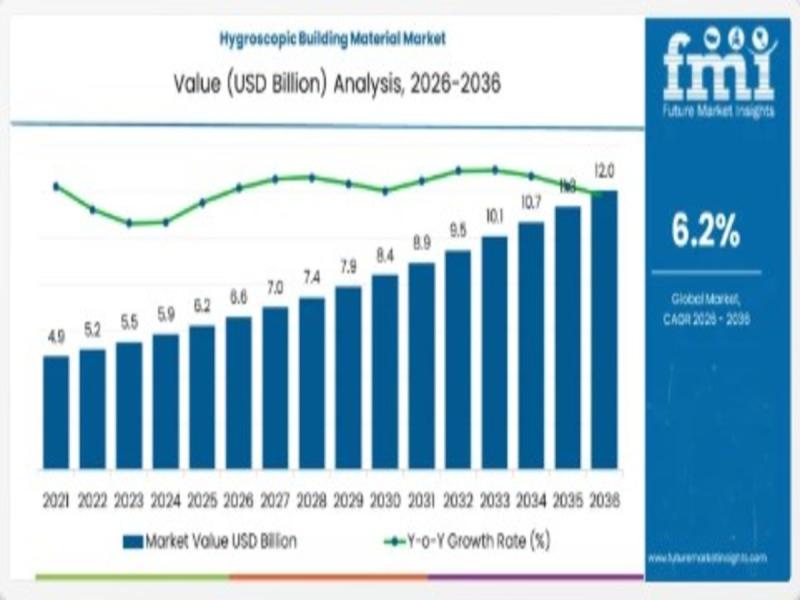
The global Hygroscopic Building Material Market – materials that absorb and release moisture to optimize indoor humidity and energy use – is projected to expand from an estimated USD 6.6 billion in 2026 to USD 12 billion by 2036, registering a robust CAGR of 6.2% during the forecast period. This dynamic growth reflects accelerating adoption of sustainability-focused construction practices that prioritize energy savings, improved indoor air quality, and long-term comfort across residential, commercial, and institutional segments.
As energy efficiency and occupant well-being become integral to modern building design, hygroscopic materials are emerging as key enablers in the transition toward greener infrastructure. From passive humidity regulation to reducing reliance on mechanical HVAC systems, these materials are reshaping traditional building assemblies within a broader global push for healthier, net-zero ready structures.
Key Market Insights at a Glance
Market performance is anchored by strong fundamentals: the market is expected to grow steadily year over year driven by increasing sustainability mandates and rising construction activity worldwide. Residential building applications account for nearly half of total demand, underscoring the importance of energy-efficient homes with superior moisture control. Wall insulation, plaster & finishing, and moisture-control panels lead application segments, with wall insulation alone commanding the largest share, reflecting its critical role in indoor climate management.
The market’s upward momentum is further catalyzed by heightened environmental awareness among developers and end-users, as well as evolving building codes that emphasize indoor air quality and reduced energy consumption. These trends have expanded the footprint of hygroscopic materials from niche applications into mainstream architectural and engineering specifications.
Request for Sample Report | Customize Report |purchase Full Report – https://www.futuremarketinsights.com/reports/sample/rep-gb-30994
Segment Overview
The Hygroscopic Building Material Market is segmented by application and end-use sector, illustrating diverse demand across building types. Wall insulation leads the application category with roughly 41% share due to its performance benefits in thermal comfort and humidity control. Residential buildings dominate end-use, contributing close to 49% of the market. Commercial and institutional construction follow, reflecting growing investment in sustainable office spaces, healthcare facilities, and educational campuses that prioritize occupant health standards.
Innovations in product formulation, including hybrid composites and engineered sorptive boards, are expanding performance profiles, enabling materials that balance hygroscopicity with durability, fire resistance, and ease of installation. These advancements are driving commercial uptake alongside traditional natural materials like wood fiber and clay plasters.
Regional Overview
Regionally, Asia-Pacific is one of the most dynamic growth arenas, with India standing out for rapid expansion driven by urbanization and carbon-neutral infrastructure goals. Growth rates in Asia-Pacific are among the highest globally, as government incentives and green certification programs encourage the use of energy-saving materials. North America maintains a strong presence, underpinned by stringent energy building codes and widespread adoption of green building standards. Europe’s mature construction market also contributes significantly, with sustainability targets reinforcing demand.
Emerging markets across Latin America and the Middle East are beginning to adopt hygroscopic materials as part of broader resiliency and climate adaptation strategies, signaling future diversification of global demand.
Competitive Landscape
The competitive landscape is marked by established global players and regional innovators advancing product portfolios and market reach. Key industry leaders are investing in R&D, strategic partnerships, and expanded manufacturing to capture rising demand. These companies are introducing moisture-buffering insulation systems, advanced composites, and integrated material solutions that align with energy performance and indoor environmental quality targets.
Market participants are also responding to customer needs for turnkey solutions that integrate seamlessly with digital building performance tools, enabling smarter specification and long-term monitoring of moisture and energy performance.
Market Outlook: Powering the Next Decade
Looking ahead, the Hygroscopic Building Material Market is poised for sustained growth over the next decade as built environments increasingly prioritize sustainability, occupant health, and energy resilience. Demand is expected to broaden beyond traditional sectors into retrofit and renovation projects aimed at upgrading existing building stock. With global construction activity on the rise, especially in developing economies, future demand will be shaped by regulatory frameworks, incentive programs, and industry collaborations that support low-carbon solutions.
Emerging trends include the integration of smart hygroscopic materials compatible with building automation systems, reinforcing real-time humidity and energy management. Additionally, as the circular economy gains traction in construction, recyclable and bio-based hygroscopic materials are gaining traction, aligning economic growth with environmental stewardship.
Key Players of Sustainable Label Industry
Market competition is led by companies committed to advanced material science and sustainability outcomes. These industry participants continue to innovate through product enhancements, geographical expansion, and strategic alliances that strengthen their positions in the rapidly expanding hygroscopic materials landscape.
Recent Strategic Developments
Strategic developments within the sector include new product launches tailored for high-performance building programs, expansion of production facilities to meet rising global demand, and collaborative partnerships with construction firms and green certification bodies. These initiatives aim to accelerate adoption, optimize supply chains, and deliver next-generation solutions that meet evolving regulatory and performance standards.
Purchase Full Report for Detailed Insights: https://www.futuremarketinsights.com/reports/hygroscopic-building-material-market
Why Choose FMI: https://www.futuremarketinsights.com/why-fmi
Explore More Related Studies Published by FMI Research:
Above the Waist PPE Market https://www.futuremarketinsights.com/reports/above-the-waist-ppe-market
PAG Base Stock Market https://www.futuremarketinsights.com/reports/pag-base-stock-market
Thymolphthalein Market https://www.futuremarketinsights.com/reports/thymolphthalein-market
Contact Us:
Future Market Insights Inc.
Christiana Corporate, 200 Continental Drive,
Suite 401, Newark, Delaware – 19713, USA
T: +1-347-918-3531
For Sales Enquiries: sales@futuremarketinsights.com
Website: https://www.futuremarketinsights.com
About Future Market Insights (FMI)
Future Market Insights, Inc. (FMI) is an ESOMAR-certified, ISO 9001:2015 market research and consulting organization, trusted by Fortune 500 clients and global enterprises. With operations in the U.S., UK, India, and Dubai, FMI provides data-backed insights and strategic intelligence across 30+ industries and 1200 markets worldwide.
This release was published on openPR.
link