


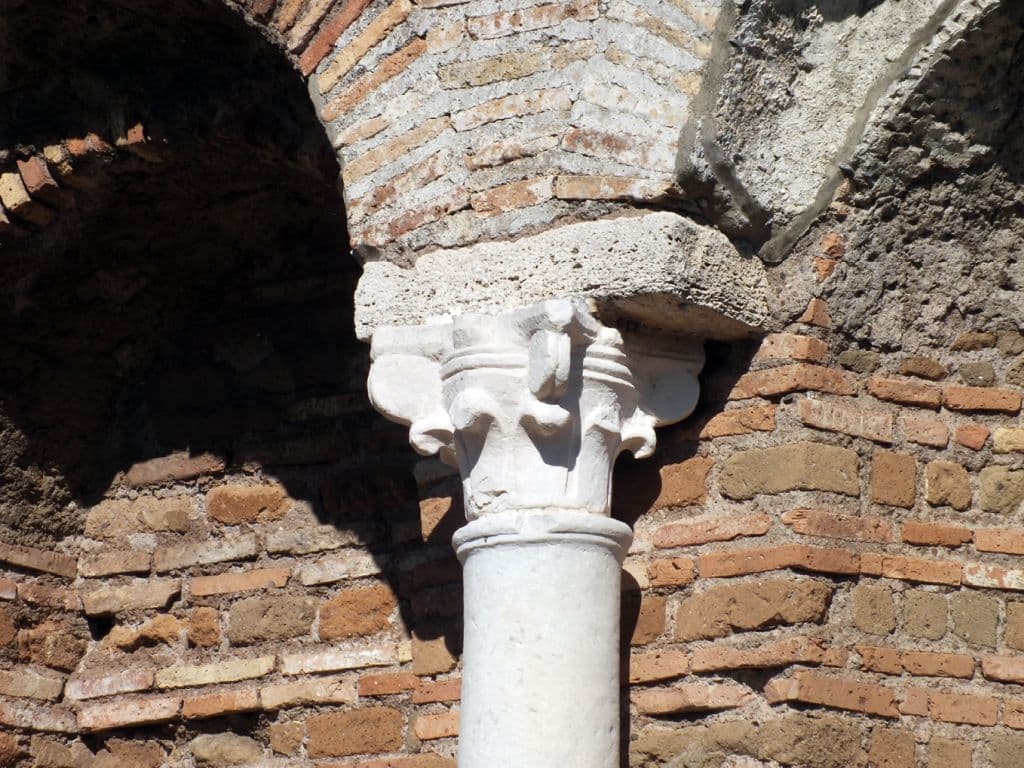
A recent study published in the journal Medieval Encounters analyzes a massive construction practice in the Late Roman Empire and the Early Middle Ages: the reuse of stones, columns, and marbles from ancient buildings. This phenomenon, known as the use of spolia (or “rediviva saxa,” stones brought back to life), has traditionally been interpreted as a symbolic, ideological, or merely economic gesture.
The article begins from a simple but powerful premise. Reusing an already carved marble block, a complete column, or a brick from a ruined building greatly simplifies the construction process. It avoids the costly work of extracting stone from the quarry, transporting it in raw form, and sculpting it. This translates directly into saving time and money.
The figures provided by the study are eloquent and result from applying modern cost-calculation methodologies to well-known monuments.
The Arch of Constantine in Rome, built largely with materials reused from imperial warehouses, cost approximately one million denarii. Had it been built entirely with new material, its cost would have soared to four and a half million denarii. In other words, the use of spolia reduced the cost of the project by 80% and shortened construction time by 65%.
The late Roman walls of Geneva and Córdoba achieved even more spectacular savings, around 90%, thanks to the dismantling of nearby buildings (such as the basilica of Nyon or the theater of Córdoba). In general, the use of reused bricks could reduce costs by 40–50%, and that of stone blocks by up to 80–90%.
These data led some scholars, such as Michael Greenhalgh, to suggest that up to 95% of cases of reuse could be explained by purely practical and economic reasons. It seems like overwhelming logic: why spend more if you can reuse?

The Paradox: The Wealthiest Were the Ones Who Reused the Most
This is where the research reveals its complexity. If the main motive were solely savings, one would expect spolia to be used mostly by patrons with fewer resources. The reality was exactly the opposite.
The study shows that in Rome, the great basilicas sponsored by the emperor or his immediate family (such as the first St. Peter’s in the Vatican or St. John Lateran) are filled with spolia in their most visible places: the majestic columns of the main naves. In contrast, the more modest churches (tituli), financed by the local aristocracy, used a higher proportion of materials carved ex novo* (from scratch).


Subscribe to our newsletter
Receive our news and articles in your email for free. You can also support us with a monthly subscription and receive exclusive content.
The abundant presence of spolia in buildings promoted mostly by the highest and wealthiest aristocracies… suggests that the cost savings achieved through their use may not have been such a decisive factor in their spread, the article notes.

This apparent paradox becomes clear when looking at the accounting of the time. The donations accompanying the construction of these great basilicas were enormous, making the savings obtained with spolia irrelevant. Constantine, for example, donated to the basilica of St. John Lateran 82 kg of gold, 775 kg of silver, and thousands of solidi in properties, solely for objects of worship and maintenance. The total cost of a large basilica could be around 20,000–25,000 solidi, but patricians such as Melania the Younger and her husband Pinianus had annual incomes of 120,000 solidi. In other words, they had more than enough money to pay for new material if they had wanted to.
So Why Did the Powerful Use Spolia?
The study proposes several interconnected reasons that go beyond economics. The largest and most valuable spolia, especially those from emblematic public buildings, were not freely accessible. Their management was controlled by the imperial state. Using them was, therefore, a privilege that the emperor granted to himself, his family, or aristocrats very close to power. Reusing a column from an imperial forum was not just about saving money; it was about displaying a direct connection to the central power and symbolically appropriating the splendor of the past.
There was an entire industry around spolia. Inscriptions and documents mention collegia of subrutores (specialists in dismantling buildings), warehouses of recovered materials (such as the Horrea of Ostia), and lists of pieces available for resale. The emperor probably controlled the flow of the largest pieces, but a market for more modest reused materials must have existed for private construction.
Starting in the 4th century A.D., the distribution channels for new marble broke down, many quarries closed, and the specialized knowledge required to carve certain elements was lost. In many cases, spolia became the only source of quality materials available for large-scale projects.

Over time, spolia acquired value in themselves, for their venustas (ancient beauty). The article cites the letter of General Belisarius to Totila (547 A.D.), in which he praises the beauty of Rome, understood as the tangible testimony of its glorious past. This appreciation could justify extravagant expenses, such as the costly transport of columns from Rome or Ravenna to Aachen for Charlemagne’s Palatine Chapel, or from Mérida to caliphal Córdoba. In these cases, ideological and prestige value far outweighed any economic consideration.
The research concludes that there is no single explanation for the phenomenon of spolia. Its use was a crossroads of economic, logistical, political, and symbolic interests. For a private builder of a house in Ostia, reusing bricks might be a purely economic decision. For Emperor Constantine, placing reused columns in St. Peter’s was an act of power, continuity, and possibly practical necessity in the absence of alternatives. For a Visigothic king or an Umayyad caliph, importing Roman columns was a way of linking themselves to the authority of the ancient Empire.
The study emphasizes that the spread of spolia responds to multiple and varied reasons, and its analysis must be carried out case by case, depending on the type of building, the status of the patrons, the cities or geographical areas, and the historical context.
Finally, the term the ancients used for this material, rediviva saxa (reborn stones), perfectly captures this dual essence. It does not speak of “remains” or “scraps,” but of a life cycle. The stone, laden with history and meaning, dies in one building to be reborn with a new function and a new message in another. A message that could be one of savings, power, devotion, or simply admiration for a past that refused to disappear.
SOURCES
Domingo Magaña, J. Á. (2025). Rediviva Saxa: Una interpretación no solo económica. Medieval Encounters, 31(5-6), 381-404. doi.org/10.1163/15700674-12340224
link