Charleston’s Art Deco buildings stand out among older styles
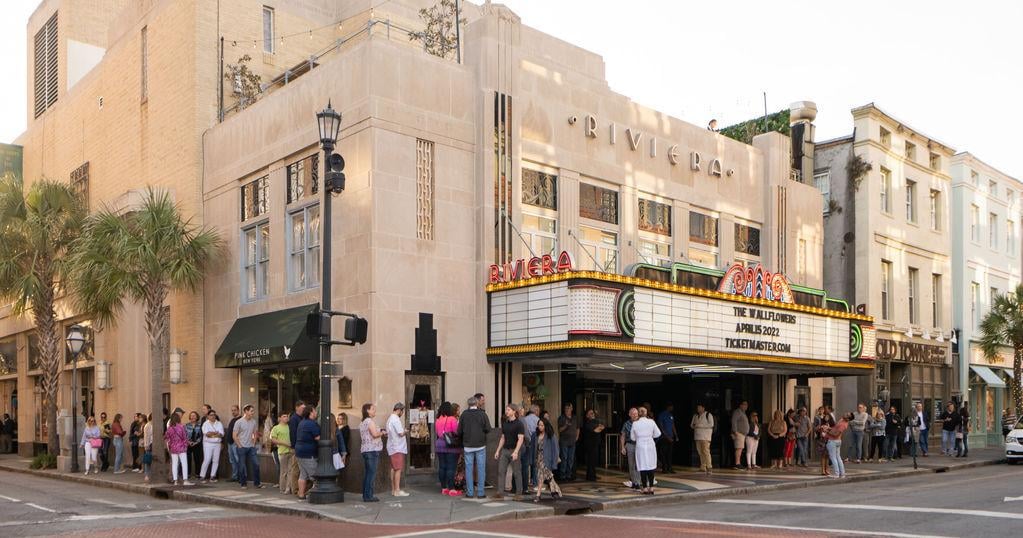
CHARLESTON — When you think of Art Deco architecture, New York City probably comes to mind, where iconic skyscrapers like the Chrysler Building, the Empire State Building and 30 Rockefeller Plaza dot the skyline. However, the Holy City is home to its own examples of the glitzy style, many that are nearing a century old.
According to the Art Deco Society of Los Angeles, Art Deco reigned from the 1920s through the 1940s. Classical European and Renaissance influences were cast aside for geometric shapes and inspiration from ancient cultures like the Egyptians and Mayans.
Some examples of Art Deco architecture on the peninsula include the American and Riviera theaters and 1000 King St., an apartment building that was once the old King Street Palace.

The premiere of Amazon Studios’ “The Map That Leads to You” is held at the American Theater, Sunday, Aug. 10, 2025, in Charleston.
Laurel Fay, the manager of preservation and research at the Preservation Society of Charleston, said that the Art Deco style is quite different from the piazza-bearing Charleston single houses and colonial-era row houses the city is known for. She said Art Deco buildings are usually built from steel, stone and brick — which varies greatly from the stucco and wood frames of many older buildings in Charleston.
Hallmarks of the style, she said, include stepped facades and vertical detailing, which oftentimes featured chrome or other metal detailing. Flowery accenting and detailed, humanistic figures were out, Fay said, and sharp lines and geometric shapes were in. She added that a non-building example of the Art Deco style is the iconic golden Oscar statuettes given to Academy Awards winners.
Fay said the Preservation Society makes a point to protect buildings of various architectural styles and periods.

Inside of the Rivera Theater on Tuesday, Nov. 22, 2022 in Charleston.
“We’re really seeing a shift — not just here in Charleston but also across the nation — where those styles are becoming more threatened with new development because there they’re deemed as not historic,” Fay said. “But those buildings encapsulate a period of architectural design that we can’t just immediately replicate.”
Saving the Riviera
One of the biggest instances of preserving Art Deco architecture is the Riviera Theater, which was constructed in 1937 and 1938. Shannon Duffy, the archivist and librarian for the Historic Charleston Foundation, said it replaced the Academy of Music, a performance venue that had opened in 1869, after that building had sustained earthquake damage and changed hands multiple times.
The new Riviera Theater was owned by Albert Sottile’s Pastime Amusement Company and operated as a movie theater from the winter of 1938-39 until 1977, she said. It reopened for nine months in 1983, during which it showed foreign language films, before closing again. Duffy said that during its closures, the Riviera — like the building before it — changed hands multiple times.

The Riviera Theater, seen here in 1981, was in a state of disrepair after years of being closed to the public.
In 1987, Charleston’s Board of Architectural Review, which has purview over buildings 50 years and older, gave permission pending final approval for plans to transform the theater into a retail space, Duffy said. She noted that there were stipulations that the building’s owners would have to restore the marquee, facade and ticket office.
Duffy said these preservation measures came as the result of a campaign by the Friends of the Riviera, a group formed in the mid-1980s to preserve the historic theater, which at that time was nearing 50 years old. Duffy noted that the building was in pretty rough shape, with wear-and-tear and disrepair evident on the original murals lining the walls and other parts the interior.

The Riviera Theater, seen here in 1981, was in a state of disrepair after years of being closed to the public, with the building’s original murals having paint flaked off in various spots.
The Post and Courier previously reported that Raymond Knight Jr. bought the theater in 1988 and updated parts of the exterior before putting the Riviera back on the market. By the early 1990s, local leaders shifted in favor of saving the space. Then-Mayor Joseph P. Riley Jr. said at the time that “the city is not interested in a demolished theater.”
In 1993, City Council approved the purchase of the theater, which the city then leased to the company Charleston Place Associates. Beemok Hospitality Collection bought the Riviera as part of their acquisition of Charleston Place in 2021, and the Art Deco theater reopened to the public as a performance venue and event space the following year.
The importance of preservation
Valerie Perry, the interim museums director at Historic Charleston, said that different architectural styles help create the streetscapes we’ve come to know around the city.

The lobby of the Rivera Theater on Tuesday, Nov. 22, 2022 in Charleston. To celebrate one year since reopening to the public, the venue is offering a special concessions deal.
“We look at several qualifiers for a building,” she said. “How does the building fit in the context of the street? How has the building benefited the community, whether as housing or as a public building, or as a place to meet other people and convene?”
She added that the Art Deco style in particular is so different from earlier styles seen around Charleston.
“When you’re looking at it, it just has a different feel to it and a different look to it,” Perry said. “And it makes you feel happy when you look at it.”
Fay said that she understands Art Deco and more modern forms of architecture from the 20th century may not resonate with some locals who like older structures in the city, but she said it is important to think about the future when considering preserving or destroying buildings.

The Riviera Theatre was built in 1937-38 as a motion picture theater on the former site of the Academy of Music (c. 1838). Photo taken August 1983.
“You think about future generations and what we’re leaving behind for them,” she said, noting that in the early 20th century, the now-classic Queen Anne and Victorian styles were undervalued and numerous buildings were torn down as a result.
“What we think is aesthetically important or culturally relevant will change in the future, and buildings that are 50 or 75 years old now will in 50 years be even more historic and significant,” Fay added. “So, future generations have a right to have these buildings preserved.”
link