The utilization of Innovative, Eco-friendly recycled walls in the development of border regions’ educational buildings in Egypt
The central aim of this research is to evaluate the application of plastic-based walls as an innovative solution for building envelopes, with particular attention to their performance under projected climate change scenarios. To address this objective in a systematic manner, the methodology has been restructured into four main subsections: material preparation, experimental design, testing procedures, and data analysis 8,15,18,].
Context and framework
The methodology was structured to evaluate recycled plastic bricks as a sustainable alternative to conventional red bricks in educational buildings located in border regions. It encompasses four core components: material development, experimental simulations, prototype testing, and environmental as well as economic analysis. Each stage was carefully aligned with the overarching research objective—assessing the energy performance, cost-efficiency, and environmental benefits of the proposed system.
Material preparation
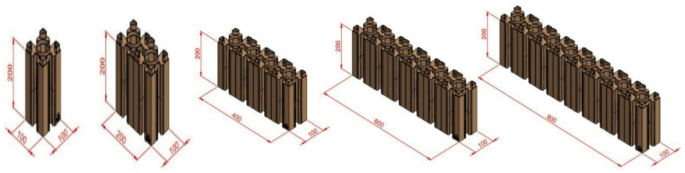
Recycled plastic bricks were produced using three primary waste streams: polyethylene terephthalate (PET) from bottle bodies, polypropylene (PP) from labels, and polyethylene (PE) from caps. The manufacturing process followed a standardized five-step sequence consisting of breaking, washing, material separation, granulation, and compression molding 14,22. The resulting HDPE/LDPE composite units were further reinforced with polypropylene connectors and recycled organic fibers to enhance structural stability and durability 7,11. Each unit measured 30 × 15 × 15 cm, dimensions comparable to conventional masonry blocks (Fig. 2). The physical properties of the developed bricks included an average density of 920 kg/m³ and a thickness of 0.15 m. Thermal conductivity values were calibrated and validated against prior experimental studies 14.

Preparation of plastic bricks using the raw input materials.
Material selection criteria
The selection of materials was guided by explicit criteria, namely cost efficiency 9, availability in border regions 15, thermal performance 5,17, environmental impact 16,22, and durability/reusability 7,11.
These parameters were particularly relevant to the challenges of educational facilities in border areas, where projects often face strict budget constraints, remote site conditions, climatic stresses, and ambitious sustainability goals 6,7,9. Cost efficiency was prioritized to minimize both initial construction expenses and long-term operational costs, a critical factor in publicly funded border-region schools 9.
In parallel, local or regional availability of materials was emphasized to reduce transportation costs and logistical barriers, in line with Egyptian guidelines for construction in remote areas 15.
Thermal performance was another essential criterion, as adequate insulation is required to ensure indoor comfort under the country’s diverse climatic zones, in compliance with ASHRAE standards and the givoni comfort chart 5,17.
Furthermore, the environmental impact of construction materials was assessed with reference to the ICE database and Egypt’s Energy Efficiency Code, highlighting the advantages of recycled plastics in reducing embodied energy and carbon emissions compared to conventional red bricks 16,22. Finally, durability and reusability were considered fundamental in light of desert climatic conditions and the need for temporary or relocatable facilities, where materials must withstand harsh stresses while allowing for future disassembly and reuse 7,11.
Collectively, these criteria align with previous studies on sustainable material selection for educational buildings 6,7,9 and supported the choice of recycled plastic bricks reinforced with polypropylene connectors and organic fibers.
Experimental design
A standardized classroom model provided by the General Authority for Educational Buildings was adopted as the case study 3, as shown in Fig. (3).
Two design prototypes were modeled for comparative analysis:
the first constructed with conventional red bricks (12 cm thickness, 1800 kg/m³ density) and the second employing modular recycled plastic bricks.
The simulations were conducted across three representative climatic zones in Egypt—Alexandria (moderate), Cairo (hot semi-arid), and Aswan (hot arid)—in accordance with the EREC classification 15. Thermal performance was analyzed using Design-Builder software, which incorporated typical meteorological year (TMY) weather data specific to each location 20. The operational profile reflected real classroom conditions, with 40 students occupying the space for seven hours daily (08:00–15:00), five days per week. Internal heat gains were set at 70 W/person, 15 W/m² for lighting, and 10 W/m² for equipment loads 19.
Indoor air temperature was employed as the primary thermal comfort indicator and was further validated using the Givoni bioclimatic chart 17.

Climate zones in Egypt as defined by EREC Source: Mahdy et al., 2017.
This study investigates a standardized classroom model developed by the General Authority for Educational Buildings—the government agency responsible for constructing public schools in Egypt. The case study was situated in Aswan, one of Egypt’s border regions, selected due to its educational importance and relevance to the project’s objectives. The chosen model represents a typical classroom frequently implemented in public schools to address students’ learning needs.
Two building prototypes were simulated, each consisting of a single ground floor with identical window-to-wall ratios, orientations, and envelope configurations, as illustrated in Fig. (4). The comparative analysis focused on two wall systems:
(1) conventional red brick walls.
(2) demountable recycled plastic bricks—lightweight, reusable units reinforced with polypropylene connectors and recycled organic fibers 3.
These prototypes served as the basis for both structural and environmental performance assessment.

Screenshot from Design-Builder (Version 7) interface showing energy performance simulation.
Testing procedures
-
Structural analysis: ETABS 2016 and SAFE 2016 were applied to columns, slabs, and beams, quantifying savings from reduced dead load 8,18.
-
Prototype construction: A classroom was built using recycled plastic bricks, requiring ~ 4 days compared to ~ 80 days for red brick masonry. Reassembly confirmed modularity 6,7.
-
Laboratory tests: Conducted at the National Research Center: compressive strength, fire resistance (> 60 min at 140 °C, up to 1260 °C furnace) 24, and acoustic insulation (~ 30 dB) 23.
-
Thermal performance: Indoor air temperature reduction of ~ 1.5 °C for plastic bricks vs. 0.3 °C for red bricks, corresponding to ~ 15–18% cooling energy savings 3,21.
Design-Builder software was used for thermal and environmental simulations, while ETABS and SAFE were used for structural analysis.
A prototype classroom was constructed with recycled plastic bricks, and laboratory tests were carried out at the National Research Center.
These procedures were chosen to combine predictive simulations with empirical validation, ensuring robust evaluation of the recycled plastic system 6,7,8,11,15.
A comparative case study was conducted to assess the performance of modular plastic brick walls relative to conventional red brick walls. The significantly lower structural mass of recycled plastic bricks contributes to lighter foundations, smaller column dimensions, and thinner slab requirements. This reduction translates into decreased consumption of construction materials and lower structural costs 8. Specifically, the analysis focused on savings in both ordinary and reinforced concrete, which result from the reduced dead load—the permanent weight of structural components such as walls, floors, and roofs—offered by detachable and re-mountable lightweight plastic brick systems.
A pilot classroom was constructed using the proposed recycled plastic bricks to evaluate their real-life feasibility. Field testing validated the system’s ease of installation, rapid construction process, and structural durability under actual site conditions 6. The assessment also considered the potential for transportation, disassembly, and reinstallation, demonstrating the modular adaptability of the system, as illustrated in Figs. (5) and (6).

Actual construction progress at the case study site.

Actual construction progress at the case study site.
In addition to the laboratory-based physical and mechanical tests, a pilot building was constructed using the proposed recycled plastic bricks to demonstrate the feasibility of real-life applications. This prototype was employed to evaluate the assembly process, structural integrity, and practical installation performance under actual site conditions. The field pilot testing confirmed the system’s durability, ease of installation, and potential for rapid construction, thereby complementing the simulation outcomes with empirical evidence. These findings were further supported by experimental validation conducted at the National Research Center, as illustrated in Figs. (A1–A3).
Experiments and simulation-based analyses were conducted to evaluate the temperature variations associated with different wall materials. The results indicated that classrooms constructed with recycled plastic bricks achieved an average indoor temperature reduction of approximately 1.5 °C, compared to only 0.3 °C for conventional red brick walls. This reduction translates into lower electrical demand for mechanical ventilation and space cooling, thereby enhancing energy efficiency. The simulations were carried out using the Design-Builder software, which had been previously calibrated and validated to ensure accuracy. Indoor air temperature profiles were compared for both wall types over the same operational period, as illustrated in Fig. 7 21.

Comparison of indoor temperatures for walls built with traditional red brick and with removable plastic bricks reinforced with polypropylene and recycled organic fibers, measured during the same period in 2023.
Fig. 7 illustrates the comparison of indoor air temperatures between classrooms constructed with conventional red brick walls and those built with demountable recycled plastic bricks reinforced with polypropylene connectors and recycled organic fibers, during the year 2023. Complementarily, Fig. 9 presents a bar chart summarizing the monthly temperature variations across the twelve months. The results reveal a consistent trend:
classrooms with recycled plastic brick walls maintained lower indoor temperatures than their red brick counterparts, with the temperature gap becoming more pronounced during the warmer months from June to September.
The analysis indicates that although recycled plastic bricks are primarily composed of thermoplastic materials, their engineered formulation—integrated with polypropylene reinforcement and recycled organic fibers—significantly improves thermal stability under fire exposure.
The experimental results confirmed that the units maintained structural integrity for more than 60 min under direct flame, a performance particularly critical for educational buildings in Egypt’s border regions, where rapid evacuation and occupant safety are essential. These results are summarized in Table 1.
The performance of recycled plastic brick walls aligns with international safety guidelines for non-structural partition systems, thereby supporting their application in classrooms and temporary facilities 11.
Fire resistance tests were conducted at the Housing and Building National Research Center, with the experimental setup illustrated in Figs. 8 and 9.
Table 1 presents the variation of furnace temperature (°C) with heating time (minutes). The results demonstrate a gradual temperature increase over intervals up to 480 min, ultimately reaching a maximum of 1260 °C.

Plastic brick samples after fire resistance test.

Variation of furnace temperature with heating time during fire resistance testing.
The figure presents the results of fire resistance tests on the recycled plastic brick system, carried out at the Housing and Building National Research Centre.
The tests evaluated the material’s behaviour under direct flame exposure across different heating durations and corresponding furnace temperatures. The chart illustrates that the recycled plastic brick system retains its structural integrity up to approximately 140 °C, achieving more than one hour of continuous fire resistance before the onset of melting. These results were obtained under standard testing conditions, where furnace temperatures progressively increased from 538 °C at 5 min to 1260 °C at 480 min. Although recycled plastic bricks are primarily composed of thermoplastic materials, their engineered formulation—reinforced with polypropylene and recycled organic fibers—significantly enhances thermal stability under fire exposure.
Maintaining integrity for over 60 min is particularly critical for educational buildings in Egypt’s border regions, where occupant safety and rapid evacuation are of paramount importance.
The performance complies with international safety guidelines for non-structural partition systems, supporting their application in classrooms and temporary educational facilities. Moreover, the demonstrated fire resistance complements the system’s other advantages—lightweight design, modularity, and energy efficiency—as highlighted in the previous figures. Collectively, these attributes confirm that the recycled plastic brick system can contribute to sustainable construction practices while meeting fundamental fire safety requirements. This integrated fire safety aspect strengthens the system’s potential for large-scale deployment in sustainable educational infrastructure, directly addressing stakeholder concerns about the flammability of plastic-based building materials.
Data analysis
-
Embodied energy & carbon: Calculated from ICE v3.0 database 16. Results expressed as MJ/m² and kgCO₂e/m², cradle-to-gate.
-
Economic evaluation: Based on Q2–2023 Egyptian market data, adjusted for 2024 inflation (Central Bank of Egypt) 25.
-
Sensitivity analysis: Thermal conductivity and density varied ± 10%; deviations in cooling loads remained within ± 5%, confirming robustness 21,26.
Embodied energy and carbon emissions were calculated using the ICE v3.0 database. Comparative analysis covered construction cost, implementation period, thermal insulation, and indoor comfort. Sensitivity analysis tested robustness by varying thermal conductivity and density by ± 10%. Results showed stable performance within ± 5% deviation, confirming reliability. This analytical approach was chosen to ensure transparency and reproducibility.
Embodied energy and carbon emissions for red brick and recycled plastic wall components were calculated using material unit values obtained from the ICE 3.0 database (University of Bath, 2019). The environmental impact per square meter of wall was estimated by multiplying the unit impact (MJ/kg and kgCO₂e/kg) by the corresponding material density and wall thickness. Only cradle-to-gate values were considered in this analysis 3,16, as illustrated in.Table 2.
-
Density and thickness values are based on manufacturer data and design assumptions used in the thermal simulation model.
-
Embodied Energy (EE) and Embodied Carbon (EC) values sourced from ICE v3.0 (University of Bath, 2019).
-
Only cradle-to-gate emissions considered (i.e., raw material extraction → manufacturing).
To complement the simulation-based environmental performance analysis, embodied energy and carbon emissions were calculated for the two wall construction systems: traditional red brick and recycled plastic wall blocks (Table 3).Material unit values were obtained from the ICE 3.0 database (University of Bath, 2019), a widely used source for life cycle environmental data. The environmental impact per square meter of wall surface was calculated using the following formula:
$$\begin{aligned} Impact \; (per m^{2}) & = Density \; (kg/m^{3}) \times Wall \; Thickness (m) \\ & \quad \times Embodied \; value (MJ/kg \; or \; kgCO_{2}e/kg) \end{aligned}$$
(1)
Only cradle-to-gate values were considered (i.e., emissions and energy from raw material extraction through to manufacturing), excluding transportation, use, and disposal stages 16 as illustrated in Table 3.
link